

Welcome to the Inner Compass blog, where you’ll find insights, resources, and support for navigating life transitions, religious trauma, and personal growth. Each post is designed to help you gain new perspectives and practical tools for your journey. Explore topics that matter to you and discover ways to align your life with your true values.
The Blog

Browse by category
read the blog
read the blog
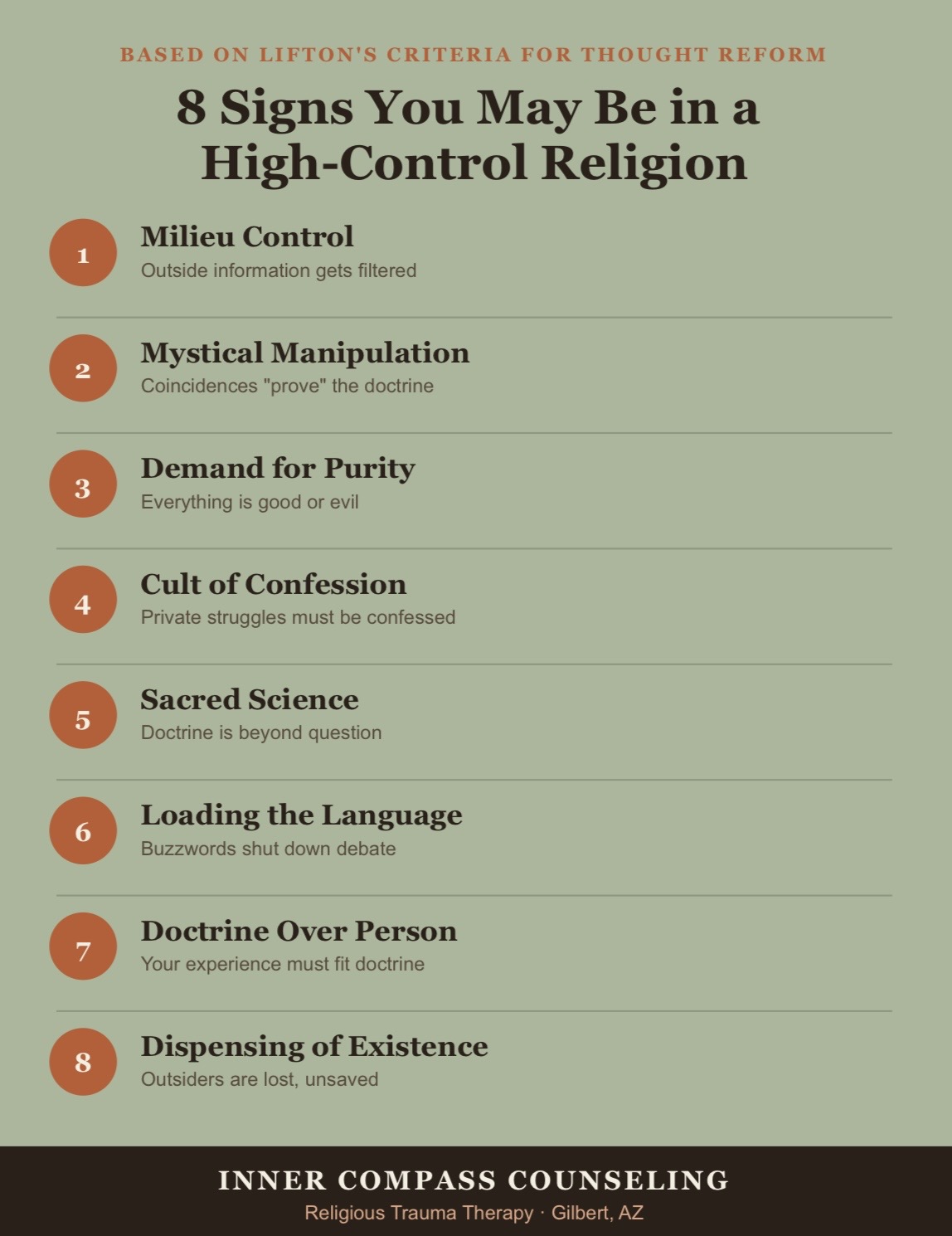
Am I in a high-control religion?’ is one of the most common questions I hear in my Gilbert office — usually asked quietly, by someone who’s already spent months or years turning it over privately before saying it out loud. It comes up often here in the East Valley, where tight-knit, high-demand faith communities are […]
FEATURED POST
READ BLOG
Written by Ashley Kirkpatrick, LAC Inner Compass Counseling & Consultation Leaving Mormonism can change a lot of things. Your beliefs. Your relationships. Your sense of community. Your understanding of sexuality. Your relationship with authority. But for many men, there is another question underneath all of that: Who am I supposed to be now? Mormonism doesn’t […]

READ BLOG
Written by Ashley Kirkpatrick, LAC It’s the end of the night. You and your partner have been flirting all evening. You’ve been affectionate. Maybe you’ve even been talking about having sex later. When you finally make a move, she says, “Not tonight. I’m exhausted.” You feel the disappointment almost immediately. You were looking forward to […]
READ BLOG
Healing is not about abandoning your values. It is about building intimacy without fear, coercion, or self-abandonment.
READ BLOG
And why we hope the next generation won’t have to wait as long On June 29, 2026 — the last day of Pride Month — Secret Lives of Mormon Wives star Layla Taylor sat down on Jay Shetty’s On Purpose podcast and said something she’d been carrying for most of her life. “I’m gay and […]
READ BLOG
Religious trauma therapy in Utah and Arizona | Inner Compass Counseling If you grew up in a faith community and something about your experience felt different from what you see portrayed as “normal” religion — more rigid, more fearful, more all-consuming — you’re not imagining it. There’s a real, definable difference between belonging to a […]

READ BLOG
A clinician’s guide to the terms we use — and why they matter. From a religious trauma therapist Gilbert AZ. As religious trauma therapists in Gilbert, Arizona, we hear these words used interchangeably almost every week: religion, spirituality, cult, abuse, trauma. And almost every week, we watch a client’s shoulders drop a little when we […]

READ BLOG
Eight tactics, one hub: control In 1993, the Domestic Abuse Intervention Project developed a framework to help survivors and clinicians understand the tactics abusers use to maintain power in intimate relationships. It’s called the Power and Control Wheel, and it has become one of the most widely used tools in domestic violence advocacy. What’s striking […]

READ BLOG
Who am I, if I’m not who they told me to be? One of the most common things I hear from clients who have left a high-control religion or cult isn’t ‘I don’t know what to believe anymore.’ It’s something quieter and more disorienting: ‘I don’t know who I am.’ Not what they believe. Not […]

READ BLOG
And What It Means for Your Healing Have you ever tried to explain your experience in a high-control religious group to someone who wasn’t there — and watched their eyes glaze over? “But wasn’t it your choice to stay?” they ask. Or: “Why didn’t you just leave?” These questions, however well-meaning, miss something fundamental: leaving […]

READ BLOG
He didn’t disappear because he doesn’t care…
He disappeared because he didn’t know how to stay.
For a lot of post-Mormon men, emotional conversations don’t feel like connection…
They feel like something to get right.
And when there’s no clear answer… the nervous system taps out.
That’s not indifference.
That’s overwhelm.


Mellissa grew up in Southern California in a large family, heavily involved in high control conservative religion. She went on to attend college at Brigham Young University-Idaho where she studied sociology and family studies. She then spent 10 years as a stay at home parent. Life pivoted for Mellissa when she experienced a divorce and faith transition and began her own work in therapy.
She spent 5 years as an educator while obtaining her masters degree in professional counseling. She has spent the last 4 years specializing her practice to help others going through major unexpected life transitions, finding healing in the present moment and creating futures that align with their core values. Mellissa’s personal experiences, combined with her specialized expertise and focused study, create a uniquely supportive and effective clinical practice for individuals navigating major life transitions.
MELLISSA'S STORY

