


How High-Control Religion Teaches Emotional Illiteracy — and Can Lead to Religious Trauma

August 30, 2026
By Mellissa Perry Hill, LPC Inner Compass Counseling & Consultation
I sit with a lot of clients, here in Arizona and connected to Utah, who tell me some version of the same thing. “I don’t know what I feel. I just know I’m supposed to feel grateful.” They can quote scripture. They can recite the rules. But when I gently ask what is happening in their body right now, in this moment, many of them go blank.
This is not a character flaw. It is not laziness or weakness. It is what happens when a person grows up in a high-control religious environment. That environment never taught them how to actually feel their feelings. It only taught them how to manage feelings, hide them, or pray them away. I call this emotional illiteracy. It is one of the quietest ways that high-control religion sets people up for religious trauma.
Religious trauma is not really about which building someone sat in on Sundays. It is not about which specific rule they broke. In my office, religious trauma is an experience, or many experiences, connected to religion, that blocks a person from true connection. That means connection to their own feelings, their own body, and the people around them. When you never learn how to feel safe enough to feel, you cannot fully connect with anyone, including yourself. That disconnection is the wound underneath so much of what I treat.
What I Mean by “High-Control Religion”
Not all religion works this way, and I want to be clear about that up front. Healthy faith, in almost any tradition, leaves room for doubt, questions, and the full range of human emotion.
High-control religion is different. It runs on strict rules, one “right” way to believe, and fear of what happens if you step out of line. Your worth is tied to how well you comply. Leaders, not your own judgment, get to decide what is true, what is safe, and what you are allowed to feel. This shows up across many faith backgrounds I work with in Arizona and Utah, including non-denominational churches, Catholic parishes, and LDS (Mormon) communities.
What Emotional Regulation and Emotional Literacy Actually Are
Emotional regulation is the skill of noticing a feeling, staying with it, and choosing a response instead of just reacting. Emotional literacy is the vocabulary and self-awareness that make regulation possible in the first place. It is knowing the difference between “I’m anxious” and “I’m angry” and “I’m grieving,” instead of just knowing “something is wrong with me.”
Children usually build these skills by watching safe adults name and handle their own emotions out loud. Sometimes that modeling never happens. Sometimes certain feelings get punished instead of explained. Either way, a person can grow into adulthood without ever developing this skill. That is what I mean by emotional immaturity. It is not about intelligence or effort. It is a skill gap, and skill gaps can be closed at any age.
How High-Control Religion Interrupts This Process
In high-control religious spaces, emotions often get sorted into two piles: safe and dangerous. Joy, gratitude, and peace are welcomed and even expected. Anger, doubt, grief, sadness, and desire are treated as red flags, or even as sin.
Therapist Elise Heerde writes about religious trauma and high-control groups. She calls this pattern “emotional filtering.” Leaders and communities reward certain feelings. They quietly shut down others, often without ever saying a clear rule out loud. A child or adult in that environment learns fast which feelings are safe to show and which ones need to disappear.
Here is the problem: the “unsafe” feelings do not actually disappear. They get pushed underground. Over time, avoidance becomes a person’s main coping skill for anything uncomfortable. That avoidance is emotional immaturity in action. It is not that the person cannot feel anger or grief or doubt. It is that they never got the chance to practice staying with those feelings long enough to learn what to do with them.
When Emotional Avoidance Turns Into Religious Trauma
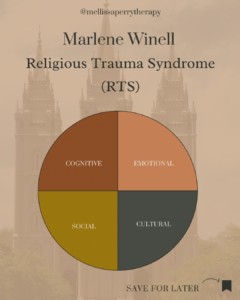
Psychologist Dr. Marlene Winell coined the term Religious Trauma Syndrome. She describes it as what happens when someone is coping with the damage of growing up in, or leaving, a strict, controlling religion. She groups the symptoms into four categories: cognitive, emotional, social, and cultural.
The emotional category includes depression, anxiety, anger, grief, isolation, and trouble feeling enjoyment. Notice how closely this overlaps with emotional immaturity and years of avoidance. When a person spends decades not being allowed to feel certain things, those feelings do not politely wait outside. They tend to show up eventually as anxiety, panic, numbness, or a nervous system that no longer knows how to settle down.
I want to add something important here, because I do not want to paint all religion or spirituality with the same brush. Research on religion and emotion regulation backs this up. A 2025 review of studies in the Journal of Religion and Health found that healthy religious and spiritual practice is often linked to better emotion regulation, not worse. Faith itself is not the enemy. What causes harm is the high-control, fear-based version of religion. That is the version that treats emotions as spies to filter out, instead of a normal part of being human.
The Generational Trauma Piece
Here is a piece I think about often. Parents who were never taught emotional regulation cannot hand their children a skill they never developed themselves. This is how generational trauma keeps moving through a family.
Therapist Sarah Ford writes about the impact of emotionally immature parenting inside religious homes. When caregivers put doctrine and compliance ahead of emotional connection, children learn to treat their own honest feelings as problems to fix or hide. Those children often grow up and become parents themselves. Without meaning to, they repeat the same pattern, because it is the only model they were ever given.
I want to be clear that this is not about blaming parents. Most of them were doing the best they could with what they were taught in their own high-control upbringing. But naming the pattern is what makes it possible to interrupt it, instead of quietly passing it to the next generation.
What Rumi’s “The Guest House” Teaches Us About Healing
I am sharing a poem on my socials today that captures what this healing actually looks like. It is called “The Guest House,” written by the 13th century poet Rumi and translated by Coleman Barks.
This being human is a guest house.
Every morning a new arrival.
A joy, a depression, a meanness,
some momentary awareness comes
as an unexpected visitor.
Welcome and entertain them all!
Even if they’re a crowd of sorrows,
who violently sweep your house
empty of its furniture,
still, treat each guest honorably.
He may be clearing you out
for some new delight.
The dark thought, the shame, the malice,
meet them at the door laughing,
and invite them in.
Be grateful for whoever comes,
because each has been sent
as a guide from beyond.
High-control religion often taught the opposite of this poem. It taught people to slam the door on certain guests and only roll out the welcome mat for the “acceptable” ones like gratitude, peace, and joy. But emotional regulation is not about eliminating hard feelings. It is about learning to open the door, let the guest in, sit with it, and ask what it came to teach you.
That is the real work of healing from religious trauma. You are not trying to become a person who never feels anger, doubt, or grief again. You are learning to welcome those guests without being taken over by them.
Church Hurt, Religious Trauma, and Emotional Illiteracy in Arizona and Utah
I practice in Arizona, and I work with a lot of people connected to Utah as well. Between non-denominational churches, Catholic parishes, and a large LDS community across both states, I see this pattern constantly. Bright, capable adults can debate scripture for an hour. But they freeze up when I ask how they actually feel about their own lives. If that sounds familiar, you are far from alone, and you are not broken. You simply were never taught a skill that no one modeled for you.
Healing Is Possible
Emotional literacy and emotional regulation can be learned at any age. So can healing from religious trauma and interrupting generational patterns before they reach your own kids. You do not have to have it all figured out before you reach out. That is actually part of the work we do together.
Our team at Inner Compass Counseling currently has two clinicians with openings: Jessica Dawson, LPC and Ashley Kirkpatrick. Learn more about them both here.
Every clinician on our team is supervised or consulted by me directly. That means when you sit down with any member of our staff, even our newest clinicians, you also get the benefit of my years of experience with religious trauma and emotional healing. You are never getting “less than.” You are getting our whole team behind you.
Stay Connected
Want more posts like this on religious trauma, emotional regulation, and healing? Subscribe to our newsletter here.

Be the first to comment